

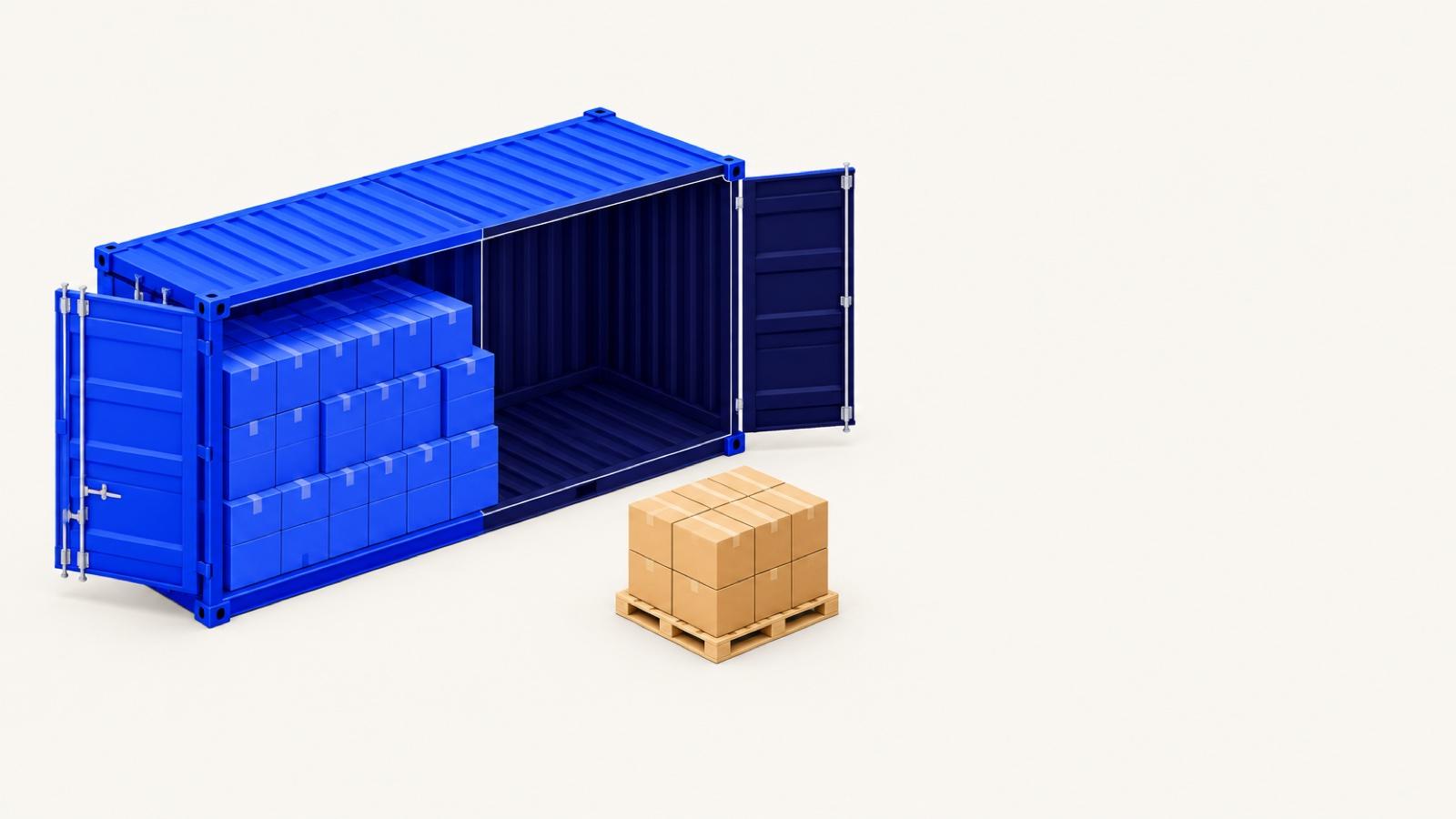
Book a full container (FCL) when your cargo fills most of one, or when the time, handling and damage risk of a shared box matter more than the saving. For smaller cargo, less than container load (LCL) usually costs less, because you pay only for the space you use. The break-even point depends on the LCL rate and the fixed charges on your route, so ask for both prices on the same date and compare them.
How LCL is priced
An LCL shipment shares a container with other customers' cargo. Maersk explains that LCL shipping "allows multiple shippers to share space in a single container", and that you "pay only for the space you use, measured in cubic metres." That is the cubic metre, or CBM, the space your cargo takes up.
Most LCL rates also check weight. Carriers and forwarders use a weight-or-measure rule, often written as W/M. The charge is based on whichever is higher: the volume in cubic metres, or the weight in metric tons. Maersk's glossary defines a weight/measurement ton as a rate assessed on "whichever will yield the carrier the greater revenue." One metric ton is 1,000 kg. Maersk's LCL terms apply the same rule where volumes are measured in weight and measure units, and set 1 CBM equal to 1,000 kg.
Here is how the rule works on one shipment. Suppose your cargo is 0.5 CBM and weighs 600 kg. The volume is 0.5 CBM. The weight is 0.6 metric tons. The higher figure is 0.6, so you are charged on 0.6 revenue tons. Weight wins, even though the boxes look small. Dense cargo, such as tools or spare parts, often charges on weight. Light, bulky cargo, such as furniture or packaging, often charges on volume.
Check the quote for the basis it uses, and for any minimum charge. A rate per W/M ton with a minimum on each shipment can cost more than the rate suggests for very small cargo.
How FCL is priced
An FCL booking pays a fixed rate for the whole container, whatever it holds. Ask whether the price includes the origin and destination charges, or whether those are extra. Maersk describes FCL as a "fixed rate per container", and says it is economical for large shipments. The price per unit falls as you fill the box. The cost is a larger upfront payment, and an empty part of the box is still paid for.
Finding the break-even point
The test is simple. Work out the LCL cost for your cargo, then compare it with the FCL cost on the same route. Both prices must include the charges at each end, or the comparison is wrong.
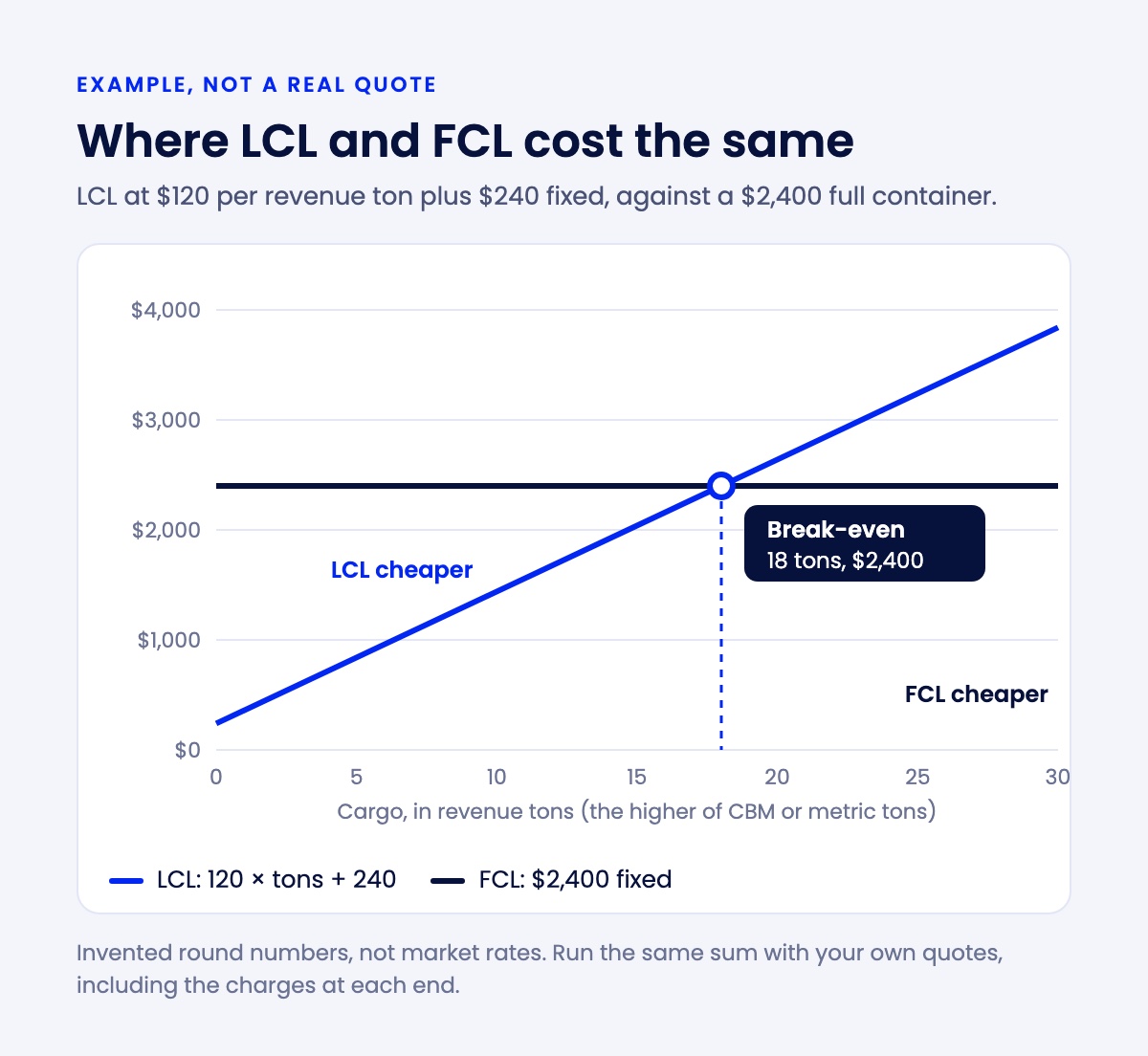
Example, not a real quote. The numbers below are round and invented for illustration. They are not market rates. Assume a full-container price of $2,400 for the route, all in. Assume the LCL rate is $120 per revenue ton, plus $240 in fixed charges per shipment for handling at both ends.
| Cargo (revenue tons) | LCL cost (120 × tons + 240) | FCL cost (fixed) | Cheaper option |
|---|---|---|---|
| 10 | $1,440 | $2,400 | LCL |
| 18 | $2,400 | $2,400 | Break-even |
| 20 | $2,640 | $2,400 | FCL |
In this example the break-even sits at 18 revenue tons. The formula is (2,400 − 240) ÷ 120 = 18. Below that, LCL is cheaper on price. Above it, the full container wins. Run the same sum with your own quotes. Change the figures and the break-even moves.
The break-even is a price test, not a service test. A cheaper LCL quote can still lose once transit time and handling are counted, as the next sections explain.
Volume changes the answer over time. A shipper that sends 8 CBM a month may do best with LCL. The same shipper, growing to 16 CBM a month, may find a full box is the better buy. Recheck the sum when your volume changes, not only when you change forwarder. A single good quote is not a plan.
Maersk gives a rule of thumb for the same question. It suggests LCL for businesses shipping "less than 15 CBM or 2–3 pallets", and FCL for "large, high-volume shipments (15–20 CBM+)". Treat these as starting points. Your own quotes decide the answer.
Transit time and handling
An LCL box is opened and closed more often. Maersk lists LCL as "slower, involves consolidation," and as "more susceptible to delays". The cargo is taken to a container freight station (CFS) at origin, where it is consolidated with other shipments, shipped, and then unloaded and split at the destination CFS. Maersk describes a container freight station as "a facility where freight shipments are consolidated or de-consolidated and staged between transport legs."
The steps add time. Each step is a place where the cargo can wait. Your shipment can be held because another customer's documents are late, or because the box is delayed at the CFS. An FCL box goes straight to the container yard (CY) for loading. Maersk notes that the CY handles only FCL, and that it works to strict cut-off times for delivering containers to the ship.
Ask the forwarder for the cut-off dates at each end, the expected days at the CFS, and the time to the consignee's door. A ten-day difference in transit can cost more than a small difference in freight.
Damage and handling risk
Every extra handling step adds a chance of damage, loss or mix-up. Maersk's comparison puts it plainly: LCL means "more handling, higher risk exposure," while FCL means "lower risk, sealed from origin to delivery." Maersk describes an FCL box as sealed from origin to delivery, with fewer stops and less mixing with other cargo. That is why it suits fragile or high-value goods.
Packing matters for LCL. Use strong cartons, label each piece with the shipment reference, and use pallets where the consolidator allows them. Ask who is liable for loss in the consolidation, and what the cargo insurance covers. Keep photos of the packing before the goods leave.
Documents: house and master bills
Documents change with the booking. On a consolidated LCL shipment, the carrier issues a master bill to the consolidator, and the forwarder issues a house bill to you. Maersk's glossary describes a house bill as one that a forwarder issues, on a back-to-back basis with the master bill, while holding the cargo until the customer pays. Your house bill is the document you use to take delivery, so check that its details match your commercial invoice and packing list. A mismatch in the consignee name or the cargo description can hold the goods at the port, whichever mode you choose.
On an FCL booking, the carrier's bill of lading is normally issued for the whole container. Ask your forwarder which bill you will hold, and when it will be released. A mismatch between the bill and the invoice is a common cause of a delayed release.
When each option fits
- Choose LCL when your cargo is well below a full container, the schedule is flexible, the cargo is sturdy, and the saving on price is clear after the break-even test.
- Choose FCL when your cargo is near the break-even or above it, the goods are fragile or high value, the transit time must be predictable, or the goods are going to one consignee.
- Consider a consolidated FCL when your own cargo is too small for a box but other shippers on the same lane are sending similar volumes. Your forwarder can consolidate your cargo into one master container, if it has the volume.
How Kargoplex helps with consolidation
On Kargoplex, a forwarder can open a master shipment for a container or a consolidated air waybill, and add house shipments from different customers. Shared details, such as the carrier, vessel and dates, flow down to every house shipment. Each customer keeps its own shipment, its own house documents and its own tracking, and sees its cargo as its own shipment. Box costs are allocated across the houses by weight, volume or value, and the forwarder sees the margin on the whole master. Forwarders can also fill space with partner cargo from the network, with their own rates kept private. See the consolidation platform page for how this works.
For you as a shipper, the practical benefit is simple. You get a quote on both options from the same forwarder, with the same route and date. You can then see the break-even on your own numbers, and you can ask for consolidation if your volume is small. Our guide to hidden costs in freight quotes explains which charges to check on each option.
What to ask before you book
- Quote both FCL and LCL for the same route, with the same date and the same Incoterm.
- Ask for the revenue-ton basis, the fixed charges at each end, and any minimum.
- Ask for the CFS and container yard cut-off dates, and the expected transit to your door.
- Ask which bill of lading you will hold, and when it will be released.
- Ask who is liable for damage in consolidation, and what cargo insurance covers.