

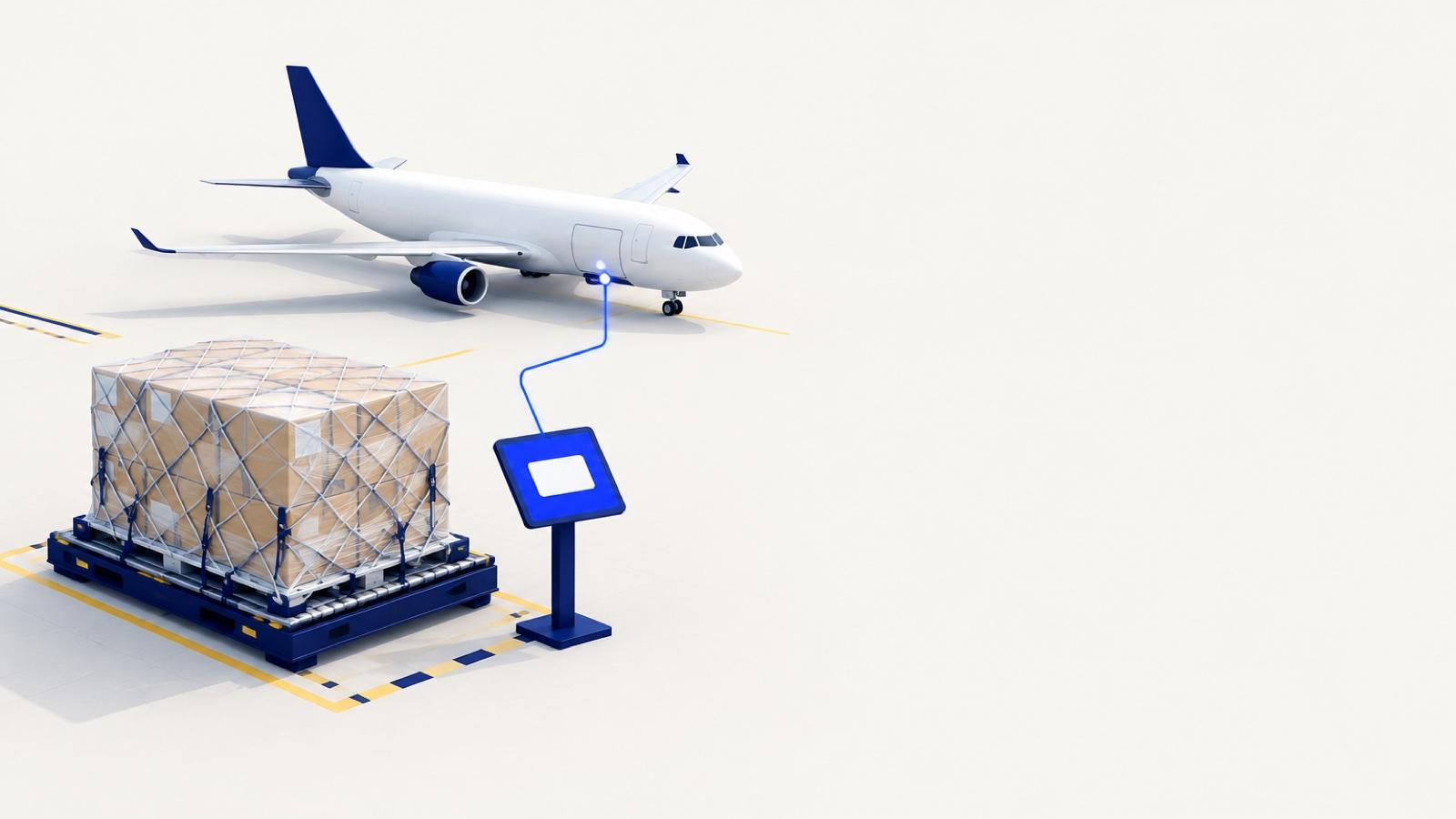
An air waybill is the document that records the contract of carriage for an air shipment. An electronic air waybill (eAWB) records the same contract as a data message, so no paper original has to travel with the cargo. IATA has made the eAWB the default on enabled trade lanes since 1 January 2019, but paper still applies in some cases. For a forwarder, the work is knowing which lanes, airlines and airports accept the eAWB, signing the right agreement, and sending clean messages.
What an air waybill is
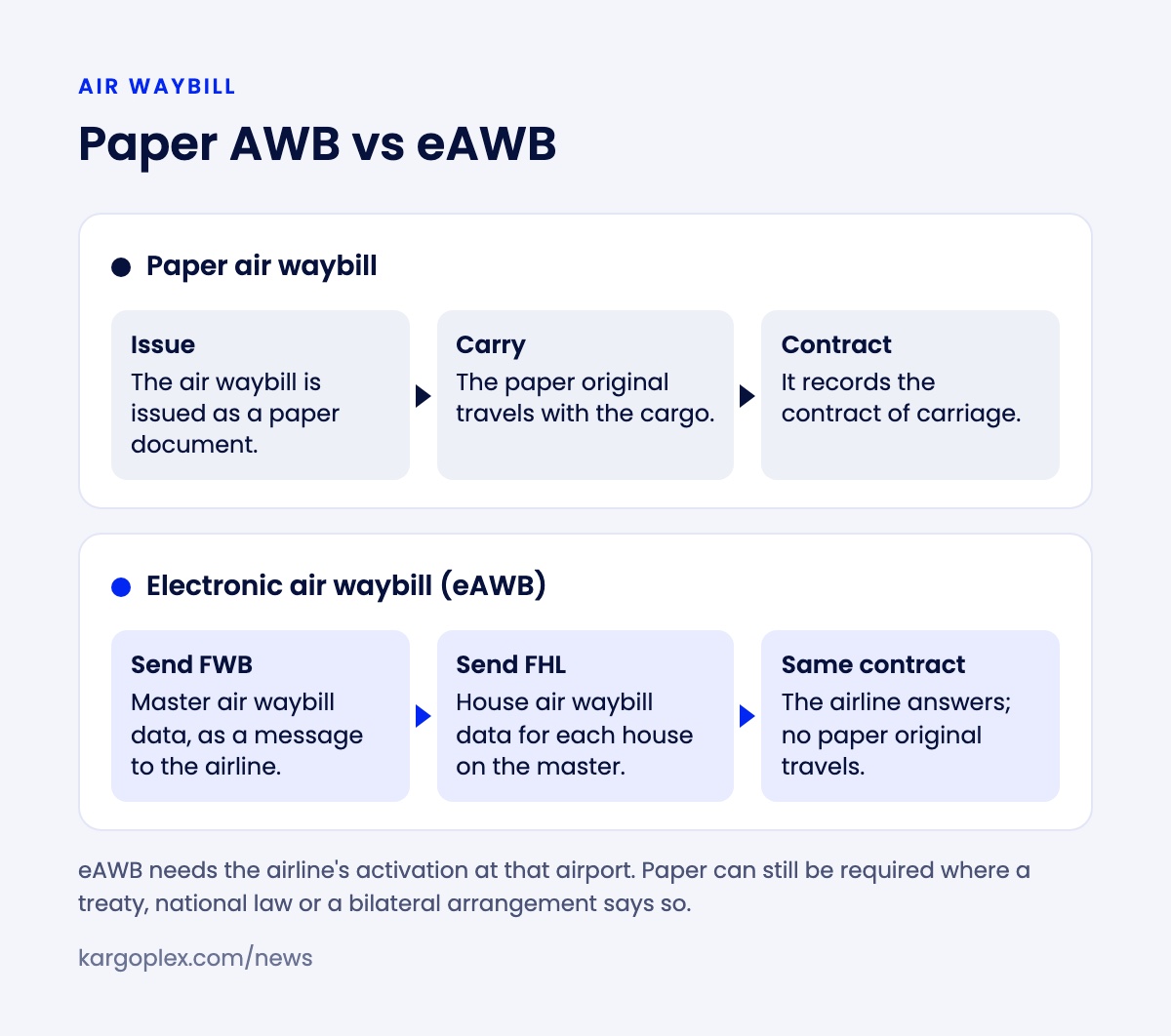
An air waybill is the transport document for air cargo. It names the shipper and consignee, the routing, the pieces, the weights and the charges. It is also the evidence of the contract between the shipper and the carrier. IATA's own description of the electronic version says it will "create and record a contract of carriage on the same basis as a paper air waybill." The paper document was the record of that contract.
That matters for the rest of this guide. The eAWB changes how the record is made and sent. It does not change what the record must say.
What an eAWB is, and where it came from
An electronic air waybill (eAWB) is the air waybill issued as a data message to the airline and the handling agents who need it. IATA introduced the eAWB in 2010, with the aim of starting the digitalisation of the air cargo supply chain. Its 2018 announcement made the eAWB the default contract of carriage for all air cargo shipments on enabled trade lanes from 1 January 2019. IATA also said that paper may still be required "due to applicable international treaties, national law, or as bilaterally agreed between the parties."
The key phrase is "on enabled trade lanes." The eAWB is not a single global switch. It works on a route where the carrier, the airport and the local rules all allow it. The answer can differ from one lane to the next, even for the same forwarder on the same day.
Where adoption stands
We could not verify a current global share of shipments sent as eAWBs. IATA's pages give the eAWB status without a date, or give older percentages in archived playbooks. So this article does not quote a share. Ask your airlines which of your lanes accept the eAWB today, and check the answer in writing.
The clearest recent step is in the Americas. In April 2025 IATA welcomed Brazil's adoption of the eAWB. A trial between December 2024 and January 2025 saw 126 shipments use an eAWB at eight Brazilian airports, with no shipment needing a physical document. Brazil is the first country in the Americas to waive the requirement for a physical air waybill. That is one country and one set of rules. It is a sign of direction, not a measure of the whole market.
The multilateral agreement: what the forwarder signs
IATA Resolution 672 is the Form of Multilateral E-Air Waybill Agreement. It lets a shipper or forwarder sign one agreement with IATA, and then exchange eAWBs with each carrier that is a party to it, instead of signing a separate deal with every airline. The resolution text sets out how it works, and four points matter in practice:
- IATA acts as agent. IATA may offer one multilateral agreement on behalf of carriers, and it publishes a list of the carriers and airport locations that take part.
- Each carrier activates you. The agreement is not effective for a forwarder until the carrier has notified it that the forwarder has met the eAWB requirements. The forwarder should not tender cargo under the agreement to a carrier until that carrier's Activation Notice has arrived. Activation applies to the airports named in the notice, so a notice for one airport is not a notice for every airport.
- Carriers choose. The resolution does not oblige a carrier to use eAWB with every shipper, or at every location where it takes cargo.
- Conditions of carriage stay as they are. The resolution does not change the carrier's conditions of contract or its rates. It also tells carriers to check with their insurers about any paper air waybill requirement that a policy may impose.
The resolution's own text says the term "Freight Forwarder" is a placeholder for the specific shipper, agent, forwarder or other EDI counterparty, and that the agreement is not reserved exclusively for forwarders.
MAWB and HAWB: who issues what
In a consolidated air shipment there are two waybills. The master air waybill (MAWB) covers the whole load that the airline carries. The house air waybill (HAWB) is the forwarder's document for each of its own shippers inside that load. The pair is the air version of the master and house bills of lading used at sea.
IATA's messaging procedure shows how this is handled electronically. The forwarder sends the master air waybill data to the carrier in an FWB message. For each house shipment, it sends the house waybill data in an FHL message. The FWB and FHL messages are the two you will see most often in airline and airport rules. If the master and the houses disagree on pieces, weights or parties, the airline can reject the load, so the two must come from the same record.
The messages: FWB, FHL, Cargo-IMP and Cargo-XML
An eAWB is sent as a structured message. There are two message families in common use. Cargo-IMP is the older format. Cargo-XML is the newer one.
IATA's 2014 comparison of the two shows the difference in scope. Cargo-IMP is limited to ASCII 7-bit characters, runs on a private network, and covers exchanges from airport to airport. Cargo-XML uses extended UTF-8, runs over the public internet, is designed for the end-to-end supply chain, and is validated against an XML schema. The comparison is from 2014, so check current IATA guidance before you set up a system. It is still a clear guide to why the formats differ.
The format an airline accepts is set by the airline and the airport. Ask each one which message version it wants for the FWB and FHL, and whether it accepts Cargo-XML on your lanes. Do not assume that one airline's answer applies to every airport it serves.
Setting up eAWB, step by step
IATA's implementation playbook uses a simple order: check the regulatory environment, join the multilateral agreement, make sure your technology supports eAWB, make sure the electronic messages are high quality, set your business processes, and then roll out. A practical version for a forwarder looks like this:
- List the lanes you move by air, and the airlines and airports on each one.
- Check, for each lane, whether paper is still required by treaty, national law or a bilateral arrangement.
- Sign the multilateral agreement, and ask each carrier for its Activation Notice at the airports you use.
- Choose the message format each airline wants, and test your FWB and FHL messages with one airline first.
- Write down who checks each message before it is sent, and what happens when a carrier rejects one.
- Train staff on the rejected-message route, not only on the happy path.
Common pitfalls
- Treating the agreement as a switch. Signing once does not make every lane paperless. Activation is per carrier and per airport, and carriers may decline to use eAWB for a given shipper.
- Assuming paper has gone. IATA's own guidance keeps paper in place where treaties, national law or a bilateral arrangement require it. Check the rule for each destination.
- Mismatched houses and masters. A master that does not match its houses on pieces, weights or parties will be rejected. Build both from the same record.
- Ignoring the insurer. The resolution points out that a paper air waybill requirement can be a condition of insurance cover. Check the policy before you move a lane to eAWB.
- One answer for every airport. A carrier's activation at one airport does not cover another. Ask for the list of airports, and check it against your bookings.
- Messages nobody reads. A rejection from the carrier that sits in a shared inbox is a lost shipment. Route rejections to a named person, with a time limit.
How Kargoplex supports eAWB
Kargoplex includes eAWB in its air cargo module. From the job, the forwarder files FWB and FHL messages to more than 130 airlines, without a separate portal. The airline's answer, whether accepted, rejected or amended, appears on the master, where the team works. The MAWB and HAWB documents are printed from the same record, so they stay consistent. ULD pricing follows pivot weights, for teams that build unit load devices. Each filing is prepared in both message families: Cargo-IMP (FWB and FHL) and Cargo-XML (XFWB and XFZB), so the same job works with airlines on either format.
The air cargo module links to the wider platform. Master and house shipments come from the consolidation screens, milestones flow into tracking, and house documents come from smart documents. Check the module's current airline and message coverage with Kargoplex before you commit a lane to eAWB, because airline and airport rules change.
What to do this week
Start with one lane. Pick the airline and airport you use most, ask it for its eAWB status and its Activation Notice in writing, and test one shipment end to end. Keep the paper route open for any lane that still needs it. A forwarder that runs both routes for a while, with clear rules for which lane uses which, is in a better place than one that switched everything at once.
Example scenario
Example scenario, not a real customer. A small forwarder moves consolidated general cargo by air from one origin to two destinations. It starts with one airline on one lane. The team finds that the airline accepts the eAWB at its main airport but not at a smaller one, so the second destination keeps the paper route. A rejected FWB message is caught the same afternoon, because it is routed to the operations lead, not left in a shared inbox. After three weeks the team adds a second lane, with its activation notices on file.
Where to read next
The air waybill is one of many documents a forwarder has to get right. The forwarding TMS guide covers how a forwarder keeps the quote, the job, the documents and the invoice in one record, which is what makes a clean FWB or FHL message easier to produce.