

Incoterms are eleven three-letter trade terms. Each one says who arranges transport, who pays each cost, and where the risk of loss or damage passes from seller to buyer. The current edition is Incoterms 2020, in force since 1 January 2020. Choose the term before you ask for quotes. A quote on one term cannot be compared with a quote on another until the costs sit on the same side.
What Incoterms do, and what they leave out
The International Chamber of Commerce (ICC) describes Incoterms rules as "a set of standards used in international and domestic contracts for the delivery of goods." They answer three questions. Who does each task? Who pays for it? When do the goods stop being the seller's risk?
They do not set the price, and they do not replace the sales contract. Write the term you chose into the contract with your supplier, and onto every quote you request.
"Delivery" in Incoterms means the point where the seller's obligation ends. It is not always the point where you receive the goods. A seller can deliver at the port of shipment, while you pay for the ocean freight, and the risk is yours from that point.
The 11 rules in two groups
The rules split into two groups. The first group works for any mode of transport. The second group works only for sea and inland waterway transport, because risk there passes when goods are alongside or on board a ship.
- Any mode of transport: EXW, FCA, CPT, CIP, DAP, DPU and DDP.
- Sea and inland waterway only: FAS, FOB, CFR and CIF.
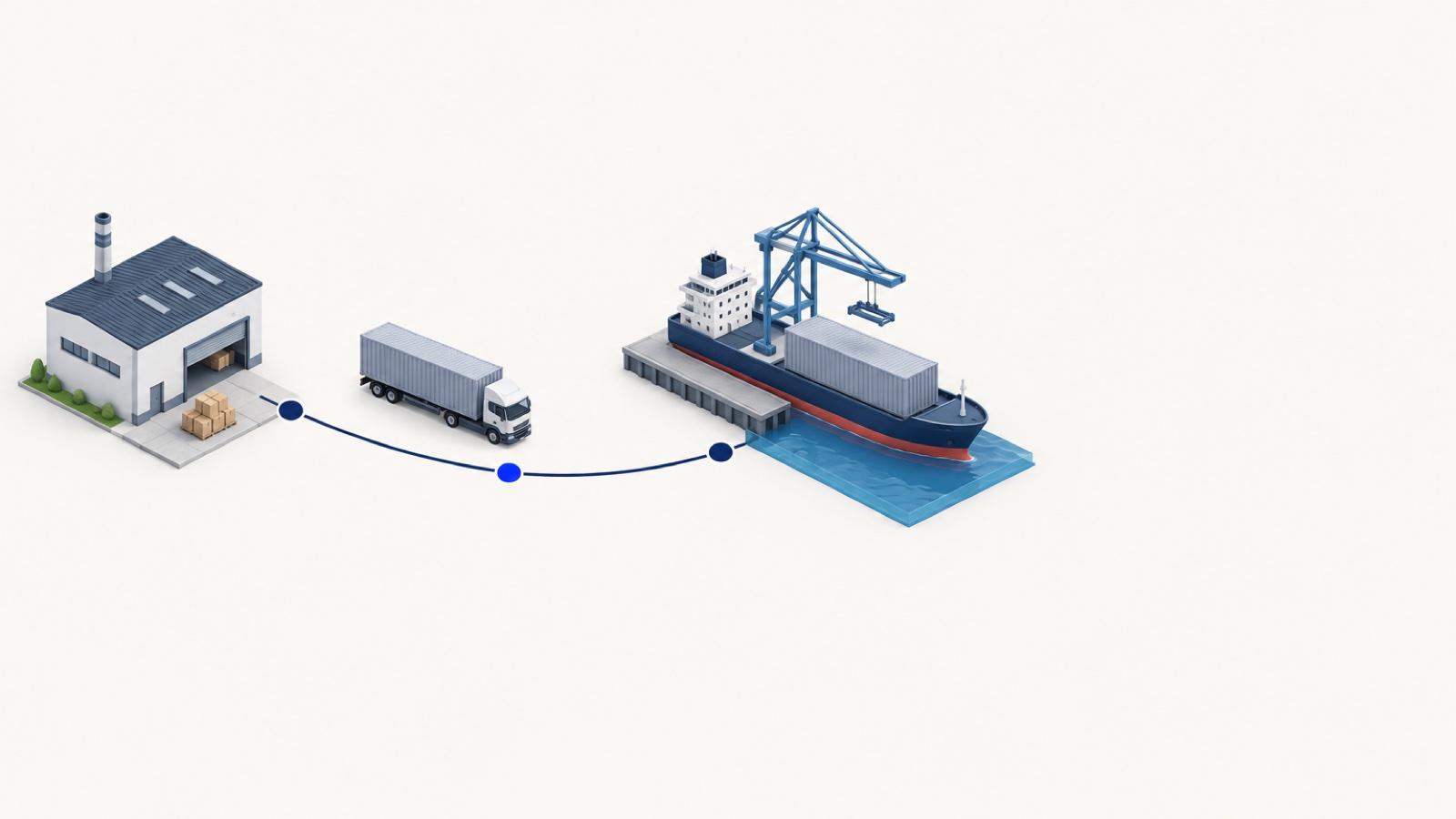
A container that travels by truck to a port and then by ship is a multimodal move. It belongs in the first group, even though a ship is part of the journey.
The one-page cheat sheet
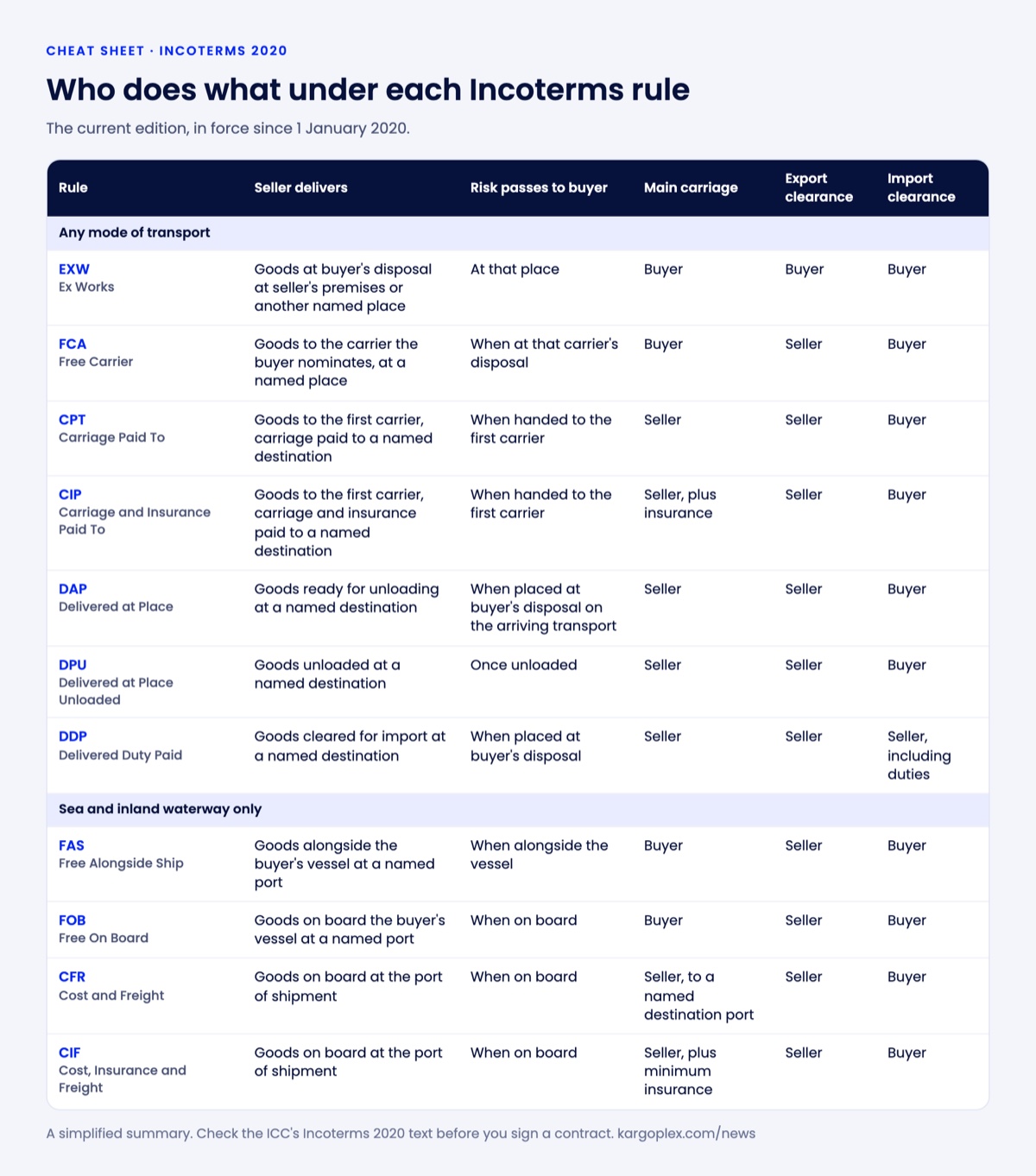
Read each row across. The columns show where the seller hands over the goods, when the risk moves, and who pays for main carriage and for each customs clearance. The last four rows are the sea and inland waterway terms.
| Term | Name | Seller delivers | Risk passes to buyer | Main carriage | Export clearance | Import clearance |
|---|---|---|---|---|---|---|
| EXW | Ex Works | Goods at buyer's disposal at seller's premises or another named place | At that place | Buyer | Buyer | Buyer |
| FCA | Free Carrier | Goods to the carrier the buyer nominates, at a named place | When at that carrier's disposal | Buyer | Seller | Buyer |
| CPT | Carriage Paid To | Goods to the first carrier, carriage paid to a named destination | When handed to the first carrier | Seller | Seller | Buyer |
| CIP | Carriage and Insurance Paid To | Goods to the first carrier, carriage and insurance paid to a named destination | When handed to the first carrier | Seller, plus insurance | Seller | Buyer |
| DAP | Delivered at Place | Goods ready for unloading at a named destination | When placed at buyer's disposal on the arriving transport | Seller | Seller | Buyer |
| DPU | Delivered at Place Unloaded | Goods unloaded at a named destination | Once unloaded | Seller | Seller | Buyer |
| DDP | Delivered Duty Paid | Goods cleared for import at a named destination | When placed at buyer's disposal | Seller | Seller | Seller, including duties |
| FAS | Free Alongside Ship | Goods alongside the buyer's vessel at a named port | When alongside the vessel | Buyer | Seller | Buyer |
| FOB | Free On Board | Goods on board the buyer's vessel at a named port | When on board | Buyer | Seller | Buyer |
| CFR | Cost and Freight | Goods on board at the port of shipment | When on board | Seller, to a named destination port | Seller | Buyer |
| CIF | Cost, Insurance and Freight | Goods on board at the port of shipment | When on board | Seller, plus minimum insurance | Seller | Buyer |
The table simplifies the rules. Check the ICC text before you sign a contract.
Where the risk moves
Cost and risk can move at different points, and this is where most confusion starts. Two examples show the difference.
- FOB: the seller's job ends when the goods are on board the vessel at the named port. The risk of loss or damage passes at the same point. After that, you pay the ocean freight, the insurance you choose to buy, and the rest of the journey.
- DAP: the seller pays the carriage to your named place, and the risk passes when the goods are ready for unloading. Import clearance is still yours.
As a rule of thumb, the "C" terms (CFR, CIF, CPT and CIP) make the seller pay for main carriage, but risk moves to you early, at the point of shipment or handover. The "D" terms (DAP, DPU and DDP) make the seller carry the risk until the goods reach the named destination. The ICC Academy describes the same split.
Two things to note. First, cost and risk can follow different paths. Under CFR, the seller pays the sea freight to your port, but the risk has already passed to you once the goods are on board. Second, the term tells you who must do each task, not whether it gets done well. Ask your supplier or forwarder to confirm in writing who will file each document, and when.
Three common mistakes
1. Using FOB for a container
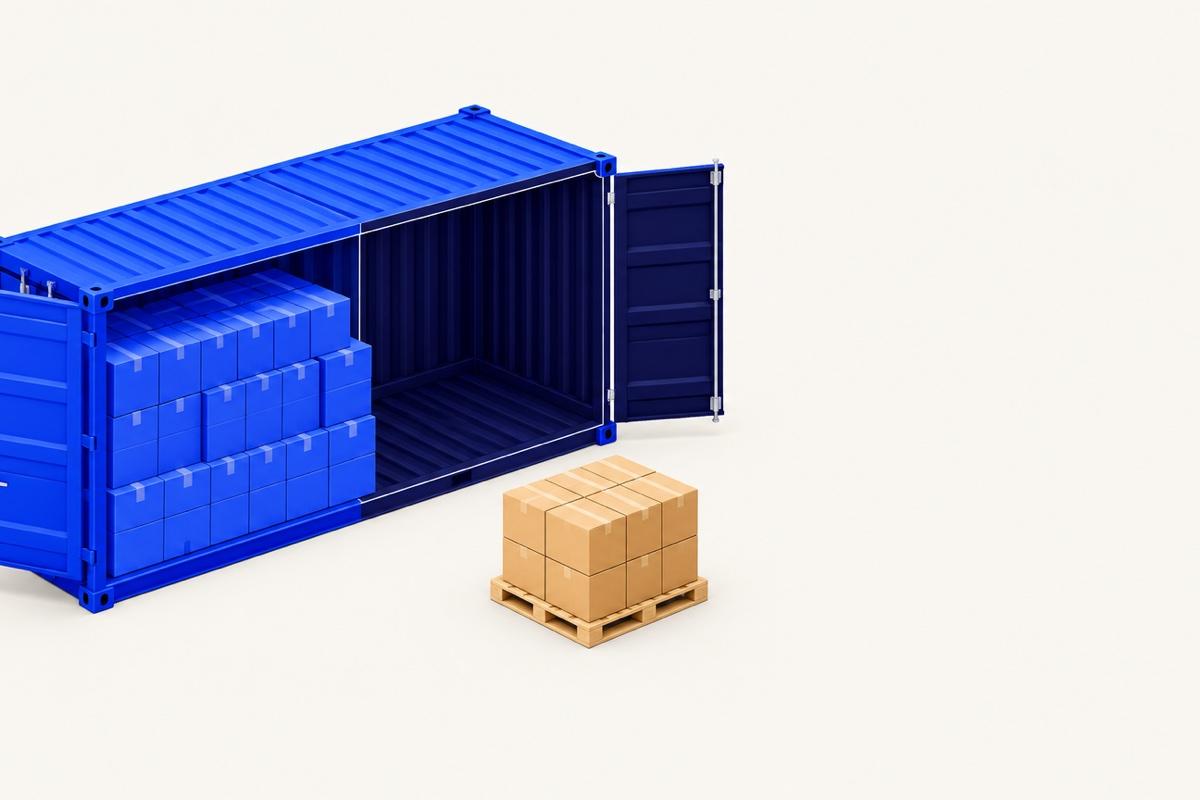
FOB is a sea-only term. The seller hands over the goods on board the vessel at the named port. A container is usually packed and sealed inland, then trucked to the port and loaded by the terminal. The ICC states that FOB "should not normally be used for container shipments." For containers, a term from the first group, such as FCA, usually fits the move better. Ask each forwarder which term its quote assumes.
2. The EXW export clearance trap
Under EXW, the seller only makes the goods available at its premises. From that point the buyer carries the loading, the export formalities and the risk. The ICC notes that "the buyer is responsible for handling any export formalities, which can lead to complications for both parties." If your supplier will not file the export declaration, you may be unable to ship at all. The ICC Academy encourages traders to consider FCA instead of EXW where goods cross a border, because under FCA the seller completes the export formalities.
3. Assuming CIF gives you full insurance
Under CIF, the seller arranges the sea freight and the insurance. The minimum is low. The rule asks for cover of the contract price plus 10 per cent (110 per cent), at Institute Cargo Clauses (C), which is the minimum level. If the goods are worth more to you, or they are fragile, that cover may not be enough. Under CIP, the seller must insure to Clauses (A), the widest cover. CIF also works only for sea transport.
The minimum is a default. Buyer and seller can agree more in the contract. Ask for the insurance certificate, and check that it covers the full value of the goods.
How to choose a term
- Work out the mode. If the goods go by ship from port to port, you can use either group. If they move by road, rail, air or in a container that is trucked to the port, use the first group.
- Decide how much the supplier should do. EXW leaves most of the work and risk with you. DDP puts most of it on the seller, and the seller usually prices that in.
- Decide who clears export and import. If you cannot clear goods in the supplier's country, do not choose EXW.
- Decide who insures the goods, and to what level. Check the minimum for the term you pick.
- Ask for every quote on the same term. Write the term on the quote and in the sales contract.
Here is a worked choice, labelled as an example only. A small importer in Lagos buys goods from a supplier in Guangzhou, and the goods travel in a container by sea. The importer can file the import entry but cannot file an export declaration in China. EXW would leave the export work with the importer, so it is a poor fit. FCA, with the supplier handing the goods to the forwarder's carrier, moves the export work to the seller. The importer then pays for main carriage and import clearance. The example is illustrative only and uses no real parties, quotes or rates.
Small importers often pick DDP because it looks simplest. It moves the most cost and risk to the supplier, so the price can rise to match. Compare the DDP price with a quote on a term where you clear the goods yourself, using the same route and the same date.
Is Incoterms 2020 still the current version?
Yes. As of November 2026, Incoterms 2020 is the current edition. The ICC's 2026 Global Policy Commissions Workplan includes starting work on a revision that it refers to as Incoterms 2030. We found no published text and no effective date for a new edition. Until the ICC publishes one, keep writing "Incoterms 2020" in your contracts, so the version is clear. A new edition does not change existing contracts on its own.
Getting quotes on the same term
Ask each forwarder to quote on the term you chose, and to name it on the quote. If a quote does not name a term, ask again before you compare prices. On the Kargoplex network, a shipper can send one request for quotes to several forwarders at once, and each forwarder replies from its own rates. Because you set the terms in the request, the answers are easier to compare. See the market network page for how requests and quotes work.
Once the term is agreed, the rest of the comparison is about the charges that sit outside it, such as destination fees and surcharges. Our guide to hidden costs in freight quotes covers those line by line.